
Implementation of the VAT Late-Filing and Late-Payment Penalty Policy
Implementation of the VAT Late-Filing and Late-Payment Penalty Policy
January 22, 2026
As of 1 January 2026, the Minister of Finance and Planning has introduced a late-compliance penalty policy for VAT-purposes. This new policy applies to tax periods starting on or after 1 January 2026 and sets out rules for the level and imposition of late-filing penalties and late-payment penalties. Both penalties may be imposed simultaneously, and each may amount to a maximum of SRD 10,000 per tax period.
In general, VAT-registered businesses have two key monthly obligations: submitting the VAT return and paying the VAT due as reported in that return. If these obligations are not met, the law provides the possibility to impose the above-mentioned penalties.
Late-filing penalty
The VAT return must be submitted no later than the 15th of each month after the tax period has ended, including nil returns and refund returns. A late-filing offense occurs when a return is filed late or not filed at all. The amount of the late-filing penalty is determined based on the length of the delay, with any exceedance of the filing deadline rounded up to whole months.
The late-filing penalty is imposed in accordance with the following table:
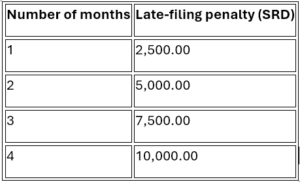
A return submitted 5 days after the deadline is rounded up to 1 month late and results in a late-filing penalty of SRD 2,500. If a return is submitted 3 months and 5 days after the deadline, this is considered 4 months late and a late-filing penalty of SRD 10,000 is imposed. For any return submitted more than 4 months after the deadline, the maximum penalty of SRD 10,000 is imposed.
Late-payment penalty
The VAT due according to the return must be paid no later than the 15th of each month after the tax period has ended. A late-payment offense occurs when payment is not made, is made late, or is insufficient.
The late-payment penalty amounts to 50% of the outstanding amount, with a maximum of SRD 10,000.
No return filed
Under the policy, failure to file a return automatically leads to the imposition of both a late-filing penalty and a late-payment penalty. If the return is subsequently submitted by way of an objection, the imposed penalties will be reconsidered. If, after objection, no payment obligation exists, the late-payment penalty will be voided.
What does this mean for you and your organization?
Prior to the introduction of this policy, the Tax Authorities (to our knowledge) did not impose late-filing and late-payment penalties in cases of non-compliance. As of January 2026, it is expected that the Tax Authorities will impose both types of penalties in accordance with this policy.
For you and your organization, this means that VAT obligations and deadlines must be monitored very closely. If penalties are nevertheless imposed despite all precautionary measures, invoking the absence of all fault or a defensible position may still provide some form of relief.
If the penalties ultimately remain in place, we would like to point out that late-compliance penalties are deductible expenses for Income Tax purposes, which may somewhat mitigate the adverse impact.
Closing
We are, of course, happy to assist you with all your VAT and tax-law related matters. If you have any questions, please feel free to contact us at any time.